Posts Tagged ‘assisted living Oak Park’
Those Thrilling Days of Yesteryear presents: “The Big Show”
 August 20th, 2013 |
  Author:
 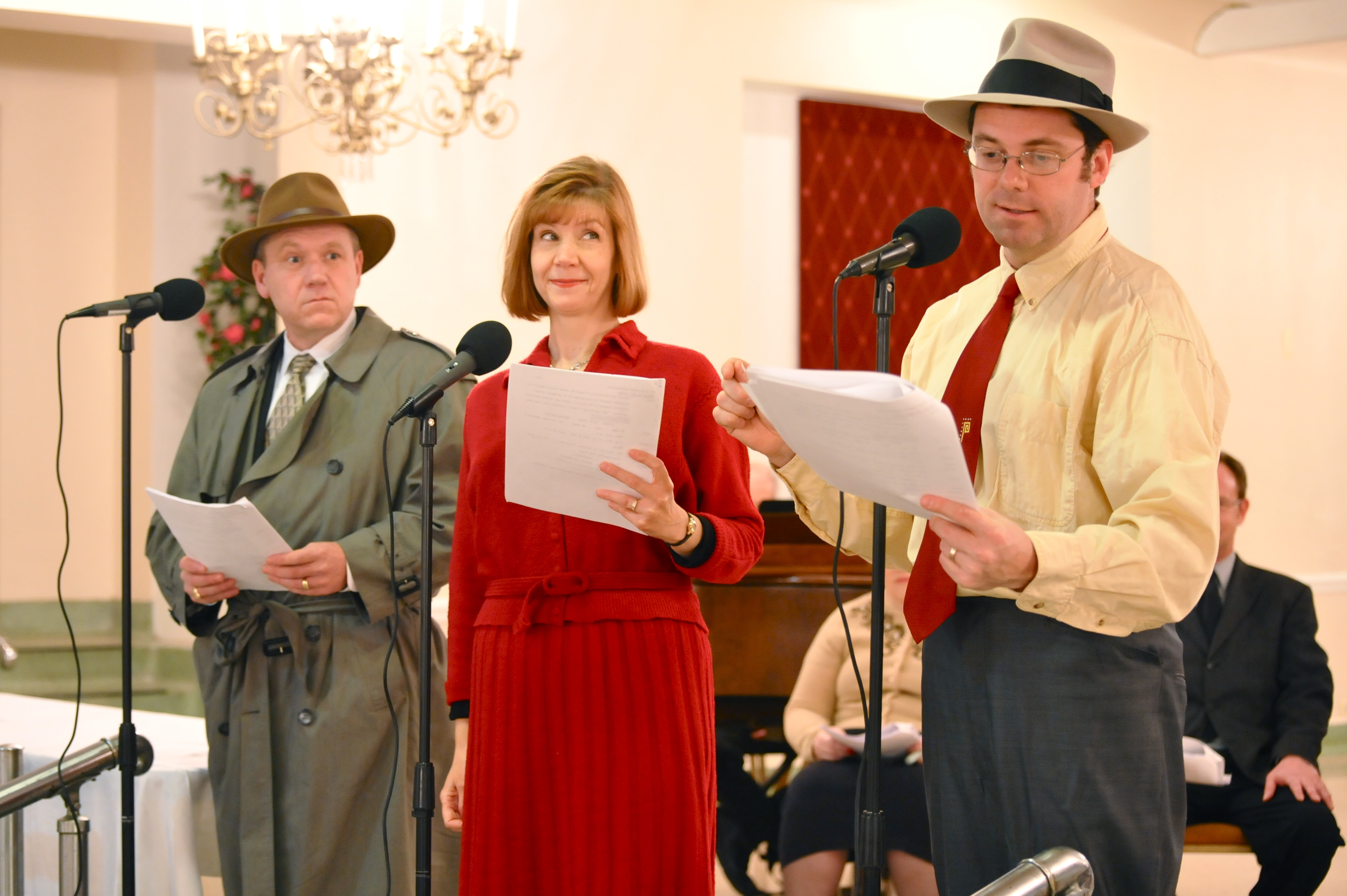 Those Thrilling Days of Yesteryear, an all volunteer radio reenactment group, will present “The Big Show” at 2 p.m. Sunday, Sept. 8, at the Oak Park Arms retirement community, 408 S. Oak Park Ave.
Originally aired on Nov. 12, 1950, “The Big Show” was hosted by Talulah Bankhead and guest starred Fanny Brice, Handley Stafford, Jane Powell, Ezio Pinza, John Agar, Frank Lovejoy, Meredith Wilson and Groucho Marx
“The Big Show” was an American comedy-variety-musical TV series that strived to revitalize what was becoming a dwindling TV genre of variety shows like the “Ed Sullivan Show” and “The Carol Burnett Show.” Using a huge stage set complete with a live audience, ice rink and swimming pool, the 90-minute time slots were always filled to capacity.
Famous guests performing skits, songs and comedic routines were regularly featured. Although the show started out with high ratings, poor reviews resulted in its cancellation just months later.
Those Thrilling Days of Yesteryear will now entertain the audience with renditions of radio’s last great variety show.
The performers
Those Thrilling Days of Yesteryear is composed of Chicagoland actors who share a common interest – to perform old time radio programs for the community. Each actor and technician donates talent and time for free.
Group founders, Ben Dooley and Pam Turlow, husband and wife, established a connection with The Oak Park Arms in September of 2002, when Turlow’s father became a resident. They’ve been volunteering/performing at The Arms ever since.
Dooley and Turlow’s group performs only once every two months due to the considerable challenges involved in creating a show. They browse through thousands of old time radio episodes, select a favorite, listen and type out the script. Many shows are not available in print and have to be painstakingly transcribed. Then they gather sound effect, rehearse and mount the show.
Sound effects were an important part of live radio shows, and the group performs them live. They have a real door for slamming, buzzers, a sound board and shoes for footsteps, and doorbells.
The shows are very popular with residents and people from the community. Some even bring their children and grandchildren to show them what entertainment was like before television.
“Since the entire cast donates its time and energy, we can only do shows six times a year,” Dooley said, “but we strive to make sure that it’s well worth the wait.”
The Oak Park Arms is a rental retirement community which provides independent and assisted living apartments and a full schedule of activities and services. Furnished apartments are also available for a short-term stay – a weekend, a week, a month or longer.
The radio show is free and open to the public. For more information, call Jill Wagner at 708-386-4040.

 Posted in Oak Park Arms |
  Tags: assisted living, assisted living Oak Park, free, Oak Park Arms, Those Thrilling Days of Yesteryear |
  No Comments »
Summer Jazz Festival: Jeremy Kahn Trio with Erich Hochberg & Eric Schneider
 The Monday Night Concert Series continues with the Jeremy Kahn Trio at 7 p.m. Monday, Sept. 30, at the Oak Park Arms, 408 S. Oak Park Ave. Musicians Eric Hochberg and Eric Schneider will be performing as well.
Kahn will perform some of the best songs of the 20th century. Referred to by Chicago Tribune’s Howard Reich as “a rare and gifted pianist,” Kahn has played in jazz venues around the world and in pit orchestras for theatrical events such as “Wicked.” In addition, he has performed with artists such as Dizzy Gillespie, Max Roach, Joni Mitchell, Phil Woods, Alvin and the Chipmunks and Aretha Franklin.
After over a decade living in New York, this Chicago native now lives in Oak Park.
Hockberg is a bassist who has worked on a variety of projects across the realms of jazz, folk, rock and blues for more than 30 years in club and concert venues around the Chicago area. He has performed and recorded with musicians such as Pharoah Sanders, Bobby McFerrin, Pat Metheny, Barbra Streisand, Diane Reeves & Willie Pickens, The Grant Park Symphony, The Joffrey Ballet and Chicago Tap Theater.
In addition, he has played on more than 1,000 jingle, television and movie soundtrack recording sessions and has participated in more than 100 album projects.
Schneider has had an extensive and successful career as a saxophonist and clarinetist participating in concerts, festivals and studio work. After graduation from the University of Illinois, Schneider recorded and toured extensively with Earl Fatha’ Hines for four years and Count Basie and his Orchestra for another two years.
Most recently Schneider performed in the Ravinia 2013 lineup playing clarinet with the Chicago Jazz Orchestra in the Tribute to Benny Goodman, which celebrated the 75th anniversary of Goodman’s Ravinia debut.
Schneider is in high demand by small groups and big bands alike. When not performing, he enjoys golf and skiing.
The Oak Park Arms is a rental retirement community which provides independent and assisted living apartments and a full schedule of activities and services. Furnished apartments are also available for a short-term stay – a weekend, a week, a month or longer.
The event is free and open to the public. Call Jill Wagner at 708-386-4040.
Posted in Oak Park Arms |
Tags: assisted living, assisted living Oak Park, free, Monday Night Concert Series, music, Oak Park Arms, Summer Jazz Festival |
No Comments »
You be the Critic: “The Package”
 Oak Park Arms presents its popular series “You Be the Critic” at 3:30 p.m. Friday, Sept. 6, at the Oak Park Arms, 408 S. Oak Park Ave. The 1989 film, “The Package,” will be viewed and reviewed with radio announcer Dan Kane.
Written by John Bishop and directed by Andrew Davis, this political thriller stars Gene Hackman, Joanna Cassidy and Tommy Lee Jones.
Thomas Boyette (Jones) is a prisoner in Germany during the Cold War placed under the supervision of Johnny Gallagher (Hackman), a U.S. sergeant responsible for bringing him back to the states. When Boyette escapes in the bathroom of the airport, it becomes Gallagher’s responsibility to find him.
With the help of his ex-wife and various old friends, Gallagher learns that his mission has gotten him involved in an assassination conspiracy involving both the U.S. and Soviet militaries.
He discovers that after a meeting with the U.S. president in Chicago, Boyette was hired to kill the leader of the Soviet Union in order to stop the signing of a disarmament treaty to eliminate nuclear weapons. Gallagher sets out to stop the plan.
The film earned more than $10 million at the box office and was awarded three stars out of four by Roger Ebert, who called it “smarter than most thrillers.”
The Oak Park Arms is a rental retirement community which provides independent and assisted living apartments and a full schedule of activities and services. Furnished apartments are also available for a short-term stay – a weekend, a week, a month or longer.
The event is free and open to the public. Call Jill Wagner at 708-386-4040.
Posted in Oak Park Arms |
Tags: assisted living, assisted living Oak Park, dan kane, free, Oak Park Arms, The Package, you be the critic |
No Comments »
Discover the Mills Investment Club
 Visitors are welcome at the next meeting of the Mills Investment Club at 1 p.m. Tuesday, Sept. 3, at the Oak Park Arms, 408 S. Oak Park Ave. New members are always welcome to join or visit.
For more than 30 years the investment club has come together to learn how to follow economic trends and use that information to expand its portfolio. With guidance from club President Pat Koko, club members jointly purchase stocks and make decisions as a group.
The club provides a fun and easy way to learn about investing by combining camaraderie, education, buying power and confidence.
“Our year-to-date is 9.7 percent right now which puts us ahead of the Dow,” Koko said. “We’ve got a variety of stocks, and we’re doing really well.”
To make the best financial choices, a special presentation is given by a different group member each month. In addition, each member is in charge of following one stock throughout the month and presenting a report of the stock’s activity.
There are currently 15 club members. To formally join, attendance to at least three meetings is required, and the final decision is voted on by the group. However, anyone can attend as often as they like without becoming a member.
The Oak Park Arms is a rental retirement community which provides independent and assisted living apartments and a full schedule of activities and services. Furnished apartments are also available for a short-term stay – a weekend, a week, a month or longer.
The event is free and open to the public. Call Jill Wagner at 708-386-4040.
Posted in Oak Park Arms, Senior Finances |
Tags: assisted living, assisted living Oak Park, banking, free, investing, Mills Investment Club, Oak Park Arms |
No Comments »
Reader’s Theatre Summer Stock Performance
 The Oak Park Arms will feature a Reader’s Theatre Summer Stock performance at 7 p.m. Monday, Aug. 26, at the Oak Park Arms retirement community, 408 S. Oak Park Ave.
A special ending will feature baritone Howard McClain singing a summertime selection.
The group was formed just six months ago. While most of the members are residents at the Arms, the group is always willing to welcome members from the outside community. In fact, they hope to partner with other groups and may do so with kids from the Oak Park Public Library’s teen readers for some intergenerational projects.
The Reader’s Theatre group will offer a wide variety of performances ranging from ensemble and script readings to poetry solos and adaptations of short stories.
Current members include: Gloria Hannas, Marion Ulrich, Paul Doolin, Marian Menges, Henry Turkowski, Charles Costello, Nancy Elsmo and Marie Munoz.
Visitors are welcome to attend weekly rehearsals at 2 p.m. on Tuesdays.
The Oak Park Arms is a rental retirement community which provides independent and assisted living apartments and a full schedule of activities and services. Furnished apartments are also available for a short-term stay – a weekend, a week, a month or longer.
The event is free and open to the public. For more information call Jill Wagner at 708-386-4040.
Posted in Oak Park Arms |
Tags: assisted living, assisted living Oak Park, free, Oak Park Arms, Reader's Theatre |
No Comments »
Summer Stock Choral Festival
The Oak Park Arms Chorus will feature a Summer Stock Choral Festival performance at 7 p.m. Monday, Aug. 19, at the Oak Park Arms retirement community, 408 S. Oak Park Ave.
The chorus first formed more than three years ago under the direction of Desi Vasquez, also the social director at the Oak Park Arms. Because members had such different levels of experience, the group began with choral selections only. They soon transitioned into solos, duets and trios, which helped strengthen their skills and confidence.
For the Aug. 19 show, they have reverted back to their roots and will perform only choral selections.
A combination of pieces has been selected ranging from light rock to blues, show tunes and traditional jazz standards like Duke Ellington’s “Satin Doll.” More contemporary pieces like “I Can See Clearly Now” will also be performed, as well as an original composition, “I Forgot.”
“Everyone has so much fun at our performances, and we’re always excited to add new members,” Vasquez said. “Our group has a vast array of experience levels, so everyone fits right in.”
While most members are residents of the Arms, there are a few community members as well. Currently members include: Howard McClain, Charles Costello, Doc Doolin, Henry Turkowski, Marian Menges, Susan Lewy, Mary Deady, Faunti Wilcoxen, Nancy Elsmo, Rose Mary Cellini, Marie Munoz and Dolores Newell.
Visitors are welcome to attend weekly rehearsals at 2:15 p.m. on Wednesdays.
The Oak Park Arms is a rental retirement community which provides independent and assisted living apartments and a full schedule of activities and services. Furnished apartments are also available for a short-term stay – a weekend, a week, a month or longer.
The event is free and open to the public. For more information call Jill Wagner at 708-386-4040.
Posted in Oak Park Arms |
Tags: assisted living, assisted living Oak Park, chorus, free, music, Oak Park Arms |
No Comments »
‘Cataract, Glaucoma & Blood Pressure’ lecture with Interim
 Interim Healthcare will present a lecture titled, “Cataract, Glaucoma & Blood Pressure,” at 10:30 a.m. Tuesday, Aug. 13, at the Oak Park Arms retirement community, 408 S. Oak Park Ave.
Blood pressure, if it is too high, can damage the small, delicate vessels that supply blood to the eyes. High blood pressure also increases a person’s risk for cataracts and glaucoma.
A cataract is a clouding of the normally clear lens of the eye, which eventually clouds the vision. Although cataracts develop slowly, with time it can become difficult to read, drive a car or even see the expression on a friend’s face. Fortunately, cataract surgery is a generally safe and effective procedure.
Glaucoma is a group of eye disorders resulting in optic nerve damage, usually caused by abnormally high pressure inside the eye. This may cause loss of vision, and is in fact one of the leading causes of blindness in the U.S.
It is estimated that over four million Americans have glaucoma but only half of those know they have it. People over 60 are considered a part of the high risk group for developing this disease. It is important to get eyes examined regularly, as early diagnosis and treatment can minimize or prevent optic nerve damage.
Interim Healthcare is the nation’s oldest healthcare franchise company. With more than 300 locations in 43 states, it provides nursing, therapy and non-medical home care, hospice and healthcare staffing.
The Oak Park Arms is a rental retirement community which provides independent and assisted living apartments and a full schedule of activities and services. Furnished apartments are also available for a short-term stay – a weekend, a week, a month or longer.
The event is free and open to the public. Seating is limited, and reservations are required. For more information call Jill Wagner at 708-386-4040.
Posted in Oak Park Arms |
Tags: assisted living, assisted living Oak Park, eye health, free, health, Interim Healthcare, Oak Park Arms, vision |
No Comments »
Handwriting Analysis with David Grayson
 A Handwriting Analysis seminar will be presented by David Grayson, a graphologist, at 2 p.m. Thursday, Aug. 8, at the Oak Park Arms retirement community, 408 S. Oak Park Ave.
Graphology is the study of handwriting and handwriting analysis based upon select assertions. Writing is seen as expressive behavior that communicates personality characteristics. It is believed that by studying an individual’s strokes, sizing and shaping, the individual’s physiological and psychological functions can be depicted. This method is becoming an increasingly popular assessment tool of an individual in organizations.
Analysis is typically conducted by evaluating the graphic stroke’s:
• pattern
• form
• movement
• rhythm
• quality
• consistency
Today experts adhere to a strict code of ethics, but the study of handwriting has a long history. It was first developed by the Chinese 3,000 years ago. It has been used by the Romans and through the centuries many civilizations and cultures have analyzed handwriting to identify that individual’s essence. While it is unclear as to why this study is successful, it continues to be an often-utilized tool to help asses a person’s character, especially in regards to one’s career or relationships.
The Oak Park Arms is a rental retirement community which provides independent and assisted living apartments and a full schedule of activities and services. Furnished apartments are also available for a short-term stay – a weekend, a week, a month or longer.
The event is free and open to the public. For more information, or to reserve a seat, call Jill Wagner at 708-386-4040.
Posted in Oak Park Arms |
Tags: assisted living, assisted living Oak Park, David Grayson, free, graphology, handwriting analysis, Oak Park Arms |
No Comments »
Exploring Music: Bruckner’s “Symphony #1″
The public is invited to a performance of Bruckner’s “Symphony #1” with Oak Park Arms resident Alfred Schoepko at 2 p.m. Saturday, July 27, at the Oak Park Arms, 408 S. Oak Park Ave.
Anton Bruckner, Sept. 4, 1824 – Oct. 11, 1896, was an Austrian composer known for his symphonies, masses and motets. His work played part in the definition of contemporary musical radicalism, owing to their dissonances, unprepared modulations and roving harmonies.
Unlike many musical radicals, Bruckner was extremely modest, showing humility before other musicians. Among his works, his symphonies in particular drew many critics commenting on their large size, use of repetition, number of revisions (often with assistance from colleagues) and indecision about what version he preferred. However, he was also greatly admired by subsequent composers, and has even been described as “half simpleton, half God.”
The Oak Park Arms is a rental retirement community which provides independent and assisted living apartments and a full schedule of activities and services. Furnished apartments are also available for a short-term stay – a weekend, a week, a month or longer.
The event is free and open to the public. Call Jill Wagner at 708-386-4040.
Posted in Oak Park Arms |
Tags: assisted living, assisted living Oak Park, Bruckner's Symphony #1, free, music, Oak Park Arms |
No Comments »
Narrow Gallery Art Opening: Frank Schaben
A wine and cheese reception will take place for the opening of a new art exhibit at 2 p.m. Sunday, July 21, in the Narrow Gallery, at the Oak Park Arms, 408 S. Oak Park Ave.
The art instillation will feature the work of abstract expressionist painter and Oak Park Arms resident, Frank Schaben.
The exhibition can be viewed daily from 9 a.m. – 5 p.m.
The Oak Park Arms is a rental retirement community which provides independent and assisted living apartments and a full schedule of activities and services. Furnished apartments are also available for a short-term stay – a weekend, a week, a month or longer.
The reception is free and open to the public. Call Jill Wagner at 708-386-4040.
Posted in Narrow Gallery, Oak Park Arms |
Tags: art, art opening, assisted living, assisted living Oak Park, free, Narrow Gallery, Oak Park Arms |
No Comments »


